
Elegance

A clean shop
Today, Maurice told us that, “All we’re after is elegance”. Obviously we were never going to achieve the correct standard of elegance while bundled up in several layers of thermals and artic wear to brave the sub-zero temperatures of the workshop at Kirkley College. So our first step to achieving the required refinement was to relocate our learning environment. We held the second day of the spoon carving module in the warmth and tranquillity of Aladdin’s Cave (a.k.a. The Woodsmith Store). Here we were spoilt by running water, indoor facilities, hot drinks, homemade soup and cookies, as well as opportunities for retail therapy. While finishing our spoons, nothing was going to stand in the way of our pursuit of elegance.
Tact and diplomacy

Caroline receiving spoon critique
As well as the need for sharp knives, suitable wood, and an understanding of a variety of safe knife grasps, a key skill in spoon carving is a good eye – or at least a practised eye. There always seems to be a point in the first part of the spoon carving journey where you lose confidence in knowing what a spoon even looks like (or maybe that’s just me). It takes time and multiple spoons to develop a feeling for what makes a good spoon. In the period of time before that is achieved, it’s worth thinking about lines and getting critique.

Giving critique
Examples of helpful advice
- “We’re looking for skinny and deep.” (referring to the neck, I think).
- “That handle has a bit of a wonk to it.”
- “That line hurts my eyeballs a bit.”
- “It looks like you enjoyed carving this section a bit too much.”
- “Can I suggest that you don’t do anything more with this one. Let this one go…”
Finishing off and homework
I came away from this module with three spoons to finish off. Two were from hazel – this first time I’ve used this wood, and one was from a recently harvest sycamore root (see Day 7 – where we searched for crooks). As expected, I also relearnt a few things, and got a bit of perspective about where I am on my spoon carving journey.
Don’t blame your tools…
He’s watching you – you’d better do a good job sharpening
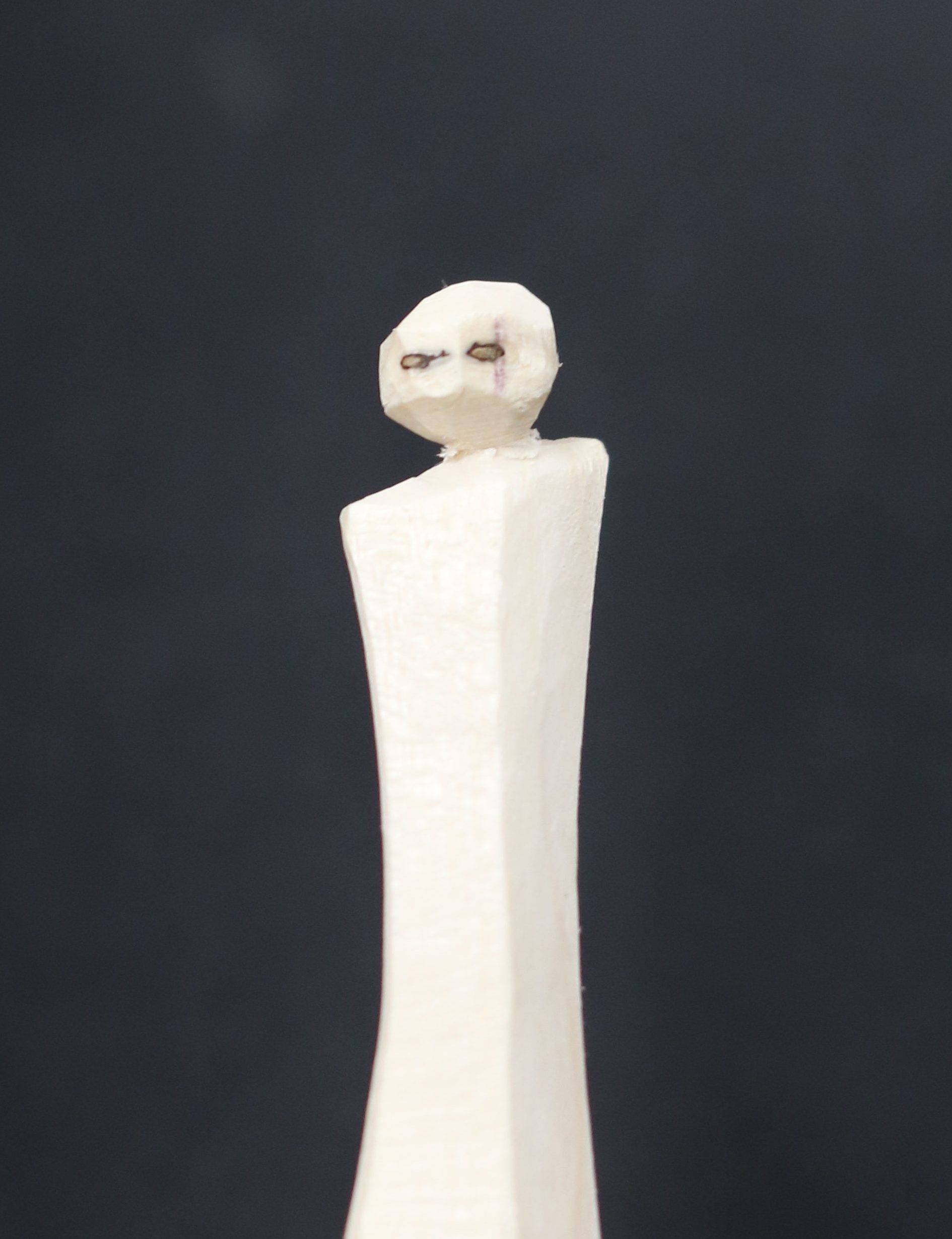
…but you can maybe blame your sharpening. If you’re struggling to make progress while carving, and the wood chips that you’re making seem diminishingly small, then don’t assume that you’ve got the wrong tool (or that you need to buy a brighter, shinier, better version), but do question whether your knives are sharp enough. It’s said that time spent sharpening is never wasted, but that’s not necessarily true. I’d say that time spent learning to sharpen well is probably more important. This is my first homework task for this week.
Don’t blame the wood…
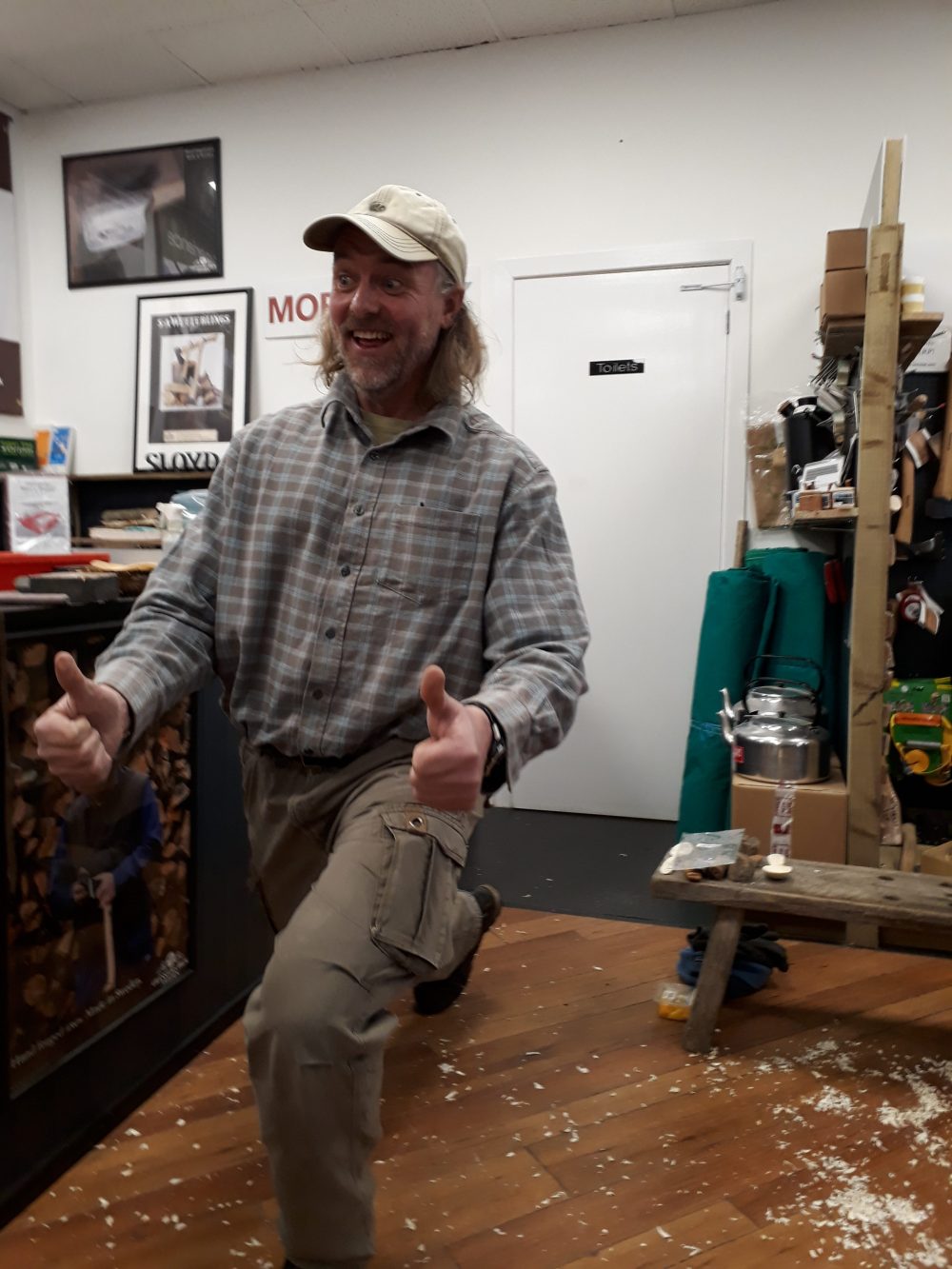
… you might be thinking that the wood you’re carving is particularly tough. And it might be. But it might also be that your knives aren’t sharpened effectively (see above), or that you’re not making efficient use of the knife. Even a sharp knife will struggle with green wood if it isn’t used effectively.
Graham trying out a thumb assisted lunge
When I first worked through Wille Sundqvist’s book – Swedish Carving Techniques (Fine Woodworking), I struggled with working out how to use some of his knife grasps. Some felt more natural to me, and these are the ones that I use mostly now. My second homework task is to revisit that book, and work through the grasps again. I’m hopeful that having gained more experience and instinct with using knives, I’ll be able to make better progress with some of the different knife grasps. I might find some new favourites.

Recent Comments