
Time
Time, time, time… there are all sorts of time! To me, for most of my life, I’m pretty heavily scheduled. My diary is packed with appointments. I plan how long things will take, and therefore what else I can fit in. Part of my brain is always aware of what’s next; it’s thinking about where I have to be, or where my son needs to be collected from.
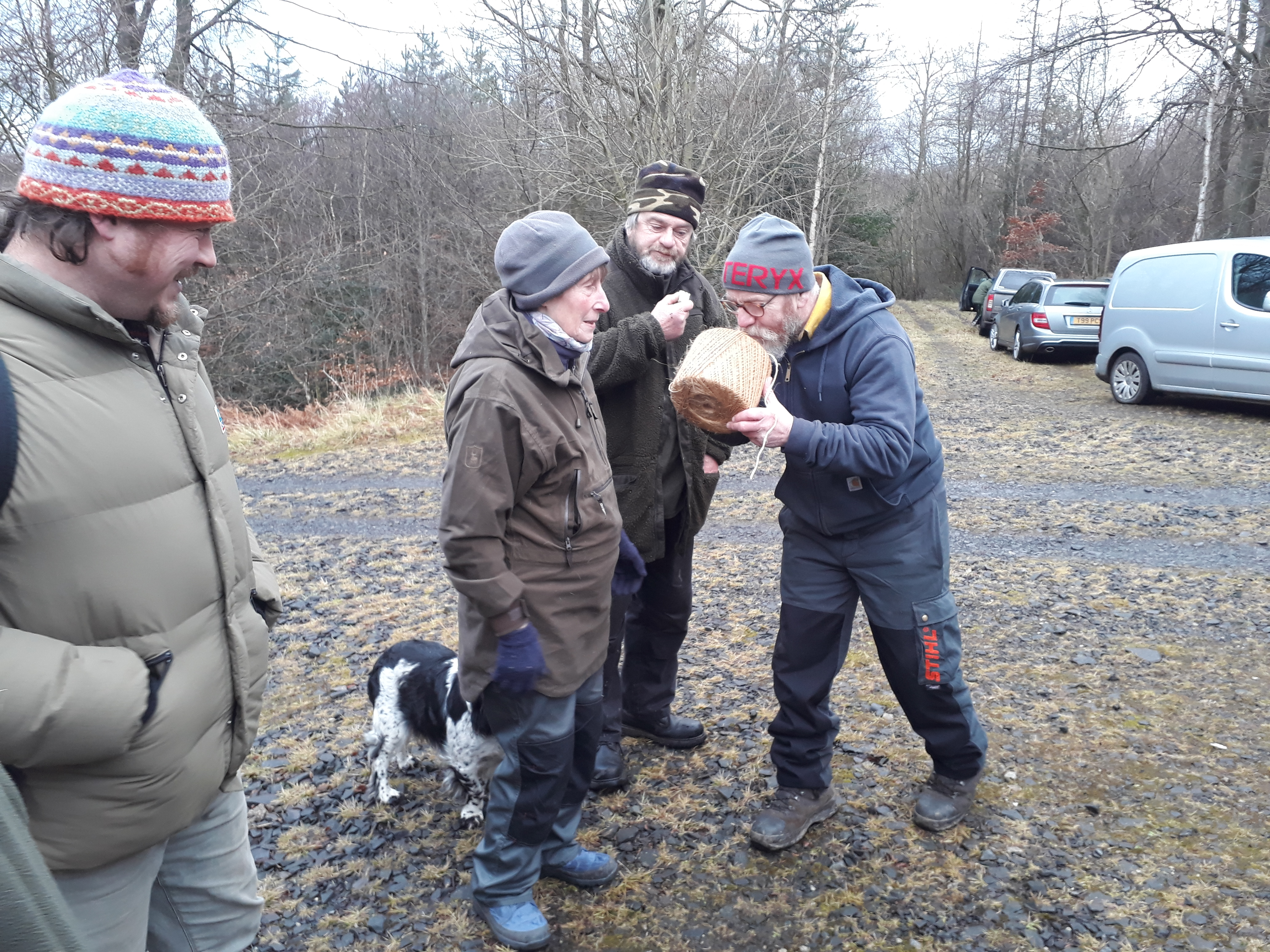
There’s always time to sniff a roll of sisal twin
I don’t know what I expected to learn from a day in the woods, but what I did learn is that there’s time. There’s time to chat, and to wander over to look at a particular tree, or stand of holly; there’s time to discuss bark and trees and buds; and there’s definitely time to sniff sisal.
I think that this lesson about time is one that I’ll have to learn a few times.
Actually what we were really doing in the woods was collecting typical coppice-type materials. The plan was to gather a few different raw materials. We’ll take them back to the workshop tomorrow to see what value we can add to them. All I wanted to do was to get on with getting my hands on some tools and doing some work, but there was time first to have a wander. And to learn some stuff. We were in some woods nearish Prudhoe that had been divided into lots. There was a mixture of new/plantation growth, and older woods. We met a couple of the owners – one was Neil (the Dad of Caroline, on our course), and the other was Bill Oakes (woodland related surnames are not essential, but definitely preferred).
Random terminology
Halo thinning: This means clearing enough conifer trees around a single broadleaf tree to create a halo of light, enabling that one tree to thrive and increase the spread of its canopy, and to let enough of the precious dappled shade that we all associate with woodland, to fall on the forest floor.
Amenity Woodland: A woodland managed primarily for amenity rather than for timber. We were in an amenity woodland (rather than commercial woodland).
PAWS: Plantation on ancient woodland site. These are ancient semi-natural woodlands on which the original, “natural” woodland is cleared, and replaced by a plantation of either native or exotic species. Part of the woods we were in for the days was PAWS. Apparently this means that if the plantation soft woods are managed, to clear some spaces for light to get in, the ancient native woods will reseed.

Hazel plantation – 3 years old
Dead wood hedge: This is created using the brash cut after clearing an area. We looked at a new hazel plantation, planted as plugs about 3 years ago. The dead wood hedge is to deter the deer. Probably the next step with this plantation would be to cut it to the ground after another year, and then wait for the next crop of straight stems.
Faggots and pimps: Other woodland words that I couldn’t resist noting down!
Spotting stuff in the woods
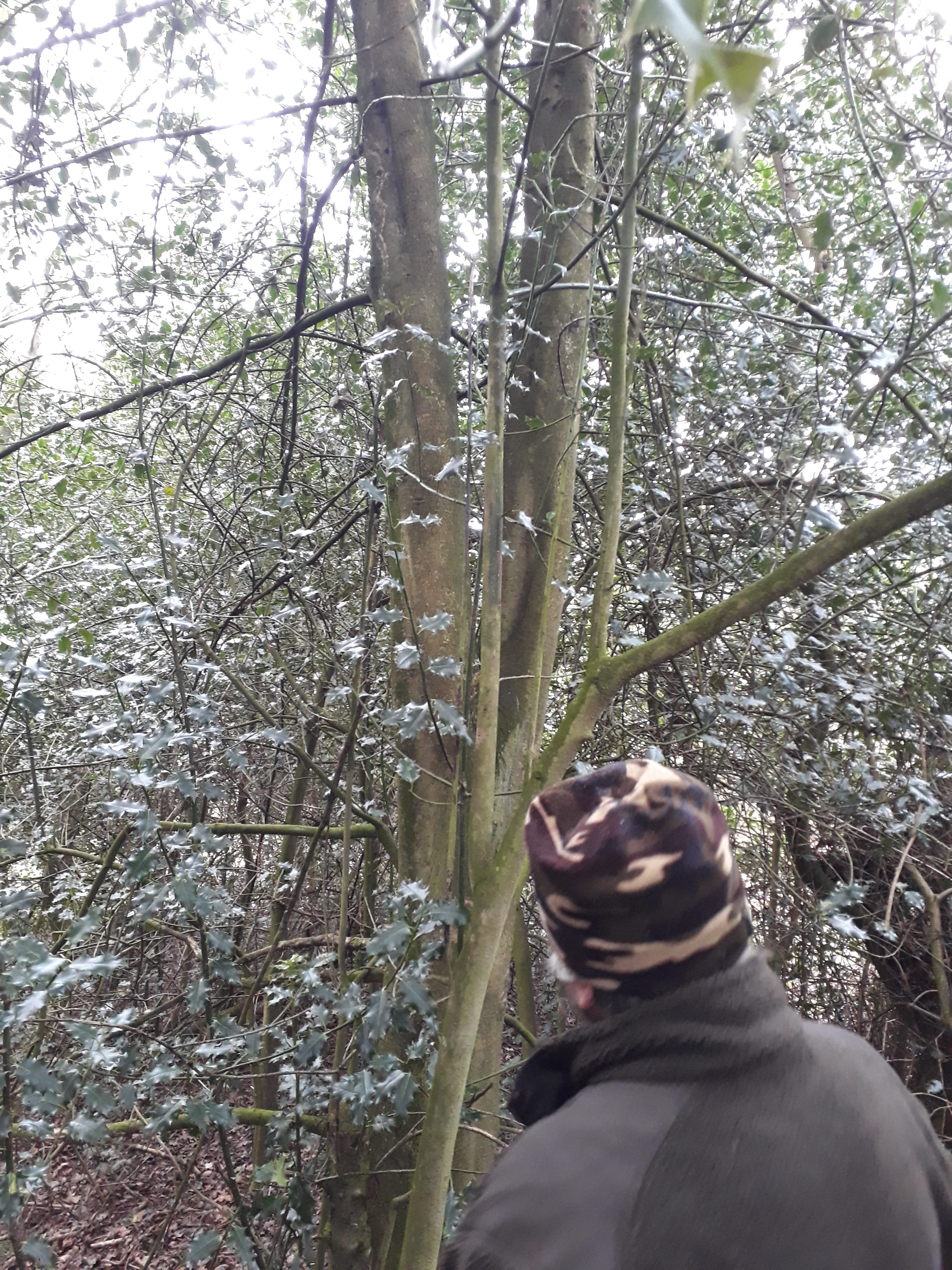
There’s a walking stick in there somewhere
There was a big stand of holly in the wood. It had layered out to make a ring of holly around a central space. Layering can happen naturally, as in this case, or you can choose to layer to increase the density of the root stock.
Holly is a diffuse porous hardwood (a hardwood having pores of uniform size and distribution throughout each annual ring). It’s waxy, and not great for greenwood working… But, one possible product might be walking sticks – do you see one growing?
Tree recognition
I’ve a lot to learn about this… But a few things I remember from today are:
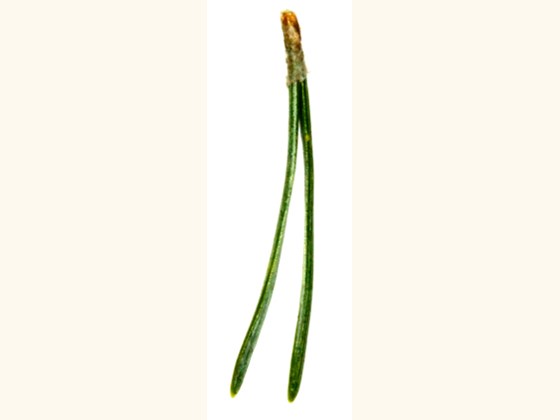
A pair of needles
“Pine in pairs” – apparently if the needles on a fir tree are in long pairs, then that’s a pine tree.

Lumpy larch
“Lumpy larch” – Larch is one of the only deciduous conifer trees. So if it looks like a fir, and it’s losing its needles, then it’s probably a larch. Once the tree has lost all the needles then it looks lumpy…

Worms hanging in the hazel
Oh, and Hazel has catkins. They look like little green or yellow worms hanging in the branches.
Work!
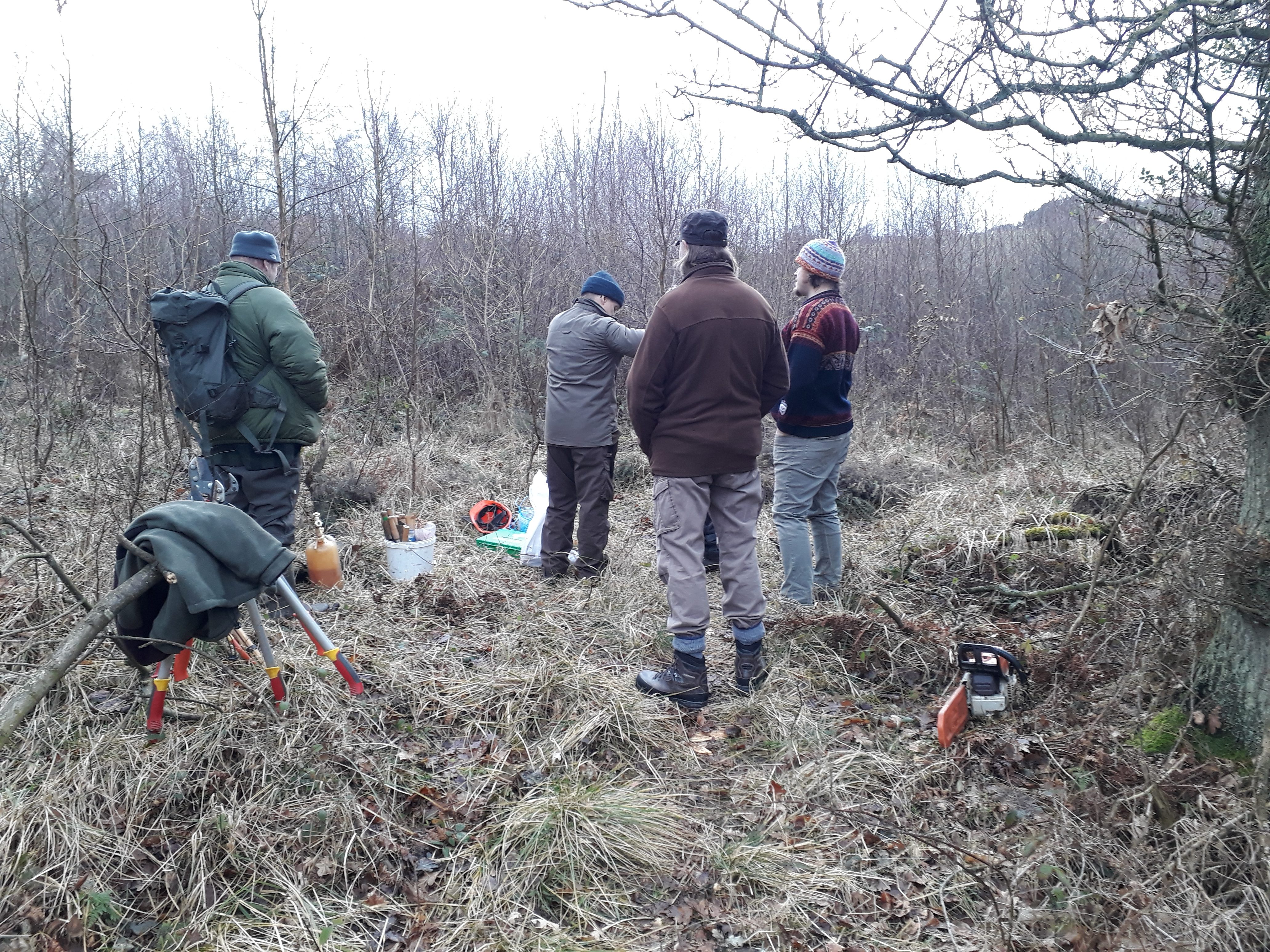
Before…
And it was finally time to get on with some work. Maurice’s experience dictated that we really needed to clear a path through some of the scrubby low growth of birch: an “extraction route”.
We sighted a path, and Maurice explained how to use a combination of billhook, loppers and chainsaw (just him) to produce piles of product.
Out of the birch we were planning to focus on four different potential product streams… birch bundles (for horse jumps), besom bundles (for besom brooms), specials (for example crooks for spoons, or potential coat hooks), and charcoal (with diameter of 1 to 4 inches, with a maximum of 5 to 6 inches).
The key skills here (apart from not injuring yourself, or anyone else) seem to be to handle the product as little as possible. Ideally you cut the birch directly onto the piles of different grades.
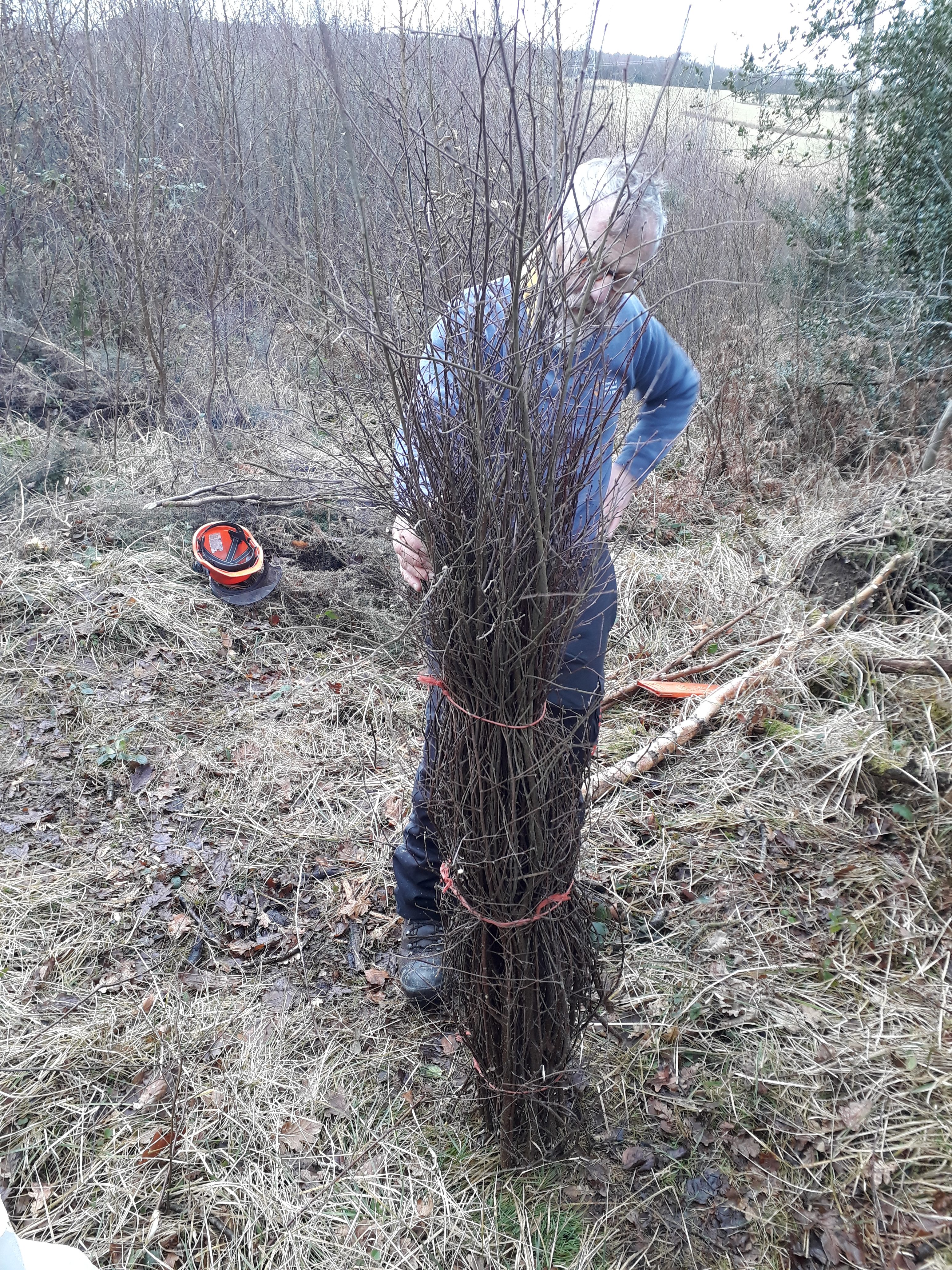
Birch bundle complete
Birch bundle key facts
6-8 foot straightish lengths (plus shorter bits if they occur), maximum diameter of butt end around 0.75 inch, around 10-12 lengths per bundle. These are be bound tightly at three intervals to make a compact bundle, using twine (but not the smelly sisal stuff). Race courses will pay good money for these (say £3-£5 per bundle). But the down side is that they’ll probably have a minimum order of 1000 bundles, and a full trailer takes around 60 bundles!
Besom bundle key facts
End of the day

… after!
Before the light faded, we got to a point where start of the “extraction route” was broadly defined. We had a pile of bundles, and some of the chunkier stems for charcoal. We loaded it onto the trailer, ready for processing tomorrow.

can’t wait to read the next exciting episode.
I can’t wait to experience the next exciting episode 😉